November: A time for Remembrance
W(ar)t: Fence at Canada's National Holocaust Monument
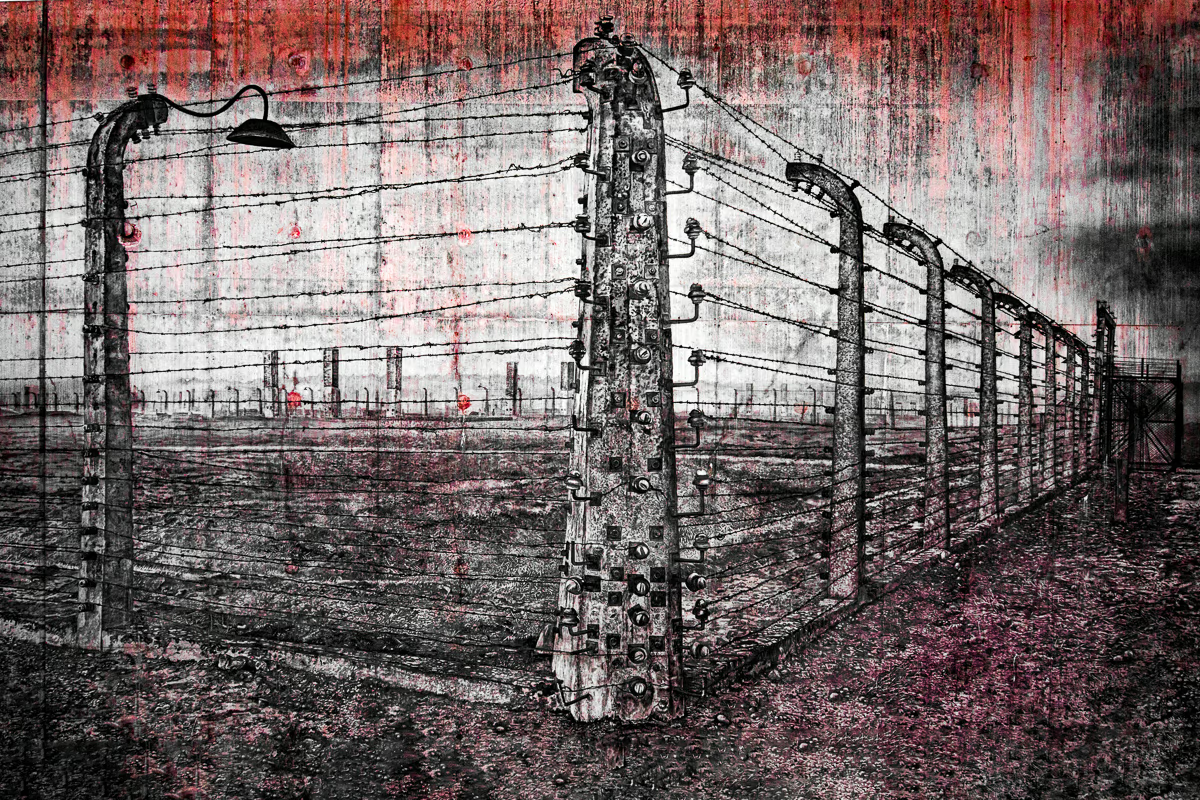
This composite image by me was inspired by Edward Burtynsky's haunting 2014 photograph, Fence, which is permanently etched into one of the massive concrete walls at Canada's National Holocaust Monument in Ottawa, Ontario.
Standing before the monument, it is difficult not to feel overwhelmed by the simplicity of the image. There are no soldiers, no crowds, no dramatic battlefield scenes. Instead, there is only barbed wire stretching across the frame. Yet few images capture the reality of Nazi oppression more effectively. The fencing depicted in Burtynsky's work echoes the barriers erected around Auschwitz-Birkenau and other killing centres, where imprisonment, terror, and mass murder became instruments of state policy.
A plaque beside the artwork notes that approximately 960,000 Jews and 120,000 Poles, Roma, Sinti, Soviet prisoners of war, and others were murdered at Auschwitz. The numbers are almost impossible to comprehend. Standing before the monument, statistics quickly give way to something more personal. The fence ceases to be a physical object and instead becomes a symbol of exclusion, dehumanization, suffering, and death.
When I look at this image, I see more than fence posts and wire. I see blood, ash, fear, and an unfathomable level of organized cruelty. I see a system built upon the idea that some people were worthy of dignity while others were not. I see how dangerous ideology can become when it is empowered by a state and accepted by enough people for long enough.
Trying to understand how such evil emerged could easily consume a lifetime of study. As author Andrea Pitzer has noted, concentration camps did not begin with Nazi Germany. Variations of them existed long before Auschwitz and have appeared in different forms throughout history. What made the Nazi system especially horrifying was the scale, industrial efficiency, and ideological commitment with which persecution and extermination were pursued.
The lesson is not merely historical. Even countries that value democracy and freedom have their own uncomfortable chapters. Canada, for example, operated internment camps during both World Wars. While these actions were nowhere near the scale or purpose of the Nazi extermination system, they nevertheless remind us that fear, prejudice, and violations of civil liberties can surface in many societies. In 1988, Prime Minister Brian Mulroney formally apologized to Japanese Canadians for their wartime internment.
History also reminds us that resistance existed. Many Germans rejected Nazism, and some, including figures such as Claus von Stauffenberg, eventually concluded that the regime itself had become intolerable and attempted to stop it from within. Their efforts ultimately failed, but they stand as a reminder that moral courage often survives even in dark times.
Western democracies were slow to confront Nazi Germany directly, but Nazism's expansionism, brutality, and worldview eventually made accommodation impossible. The resulting war exacted an unimaginable human cost, yet it also halted an ideology that denied the humanity of millions.
Today, visitors are free to walk through Canada's National Holocaust Monument and pause before this stark image of a fence. The camps are gone. The regime that built them is gone. The ideology that justified them lies discredited and condemned. Yet the warning remains, etched permanently into stone.
Lest we forget.